- English
- French
- German
- Portuguese
- Spanish
- Russian
- Japanese
- Korean
- Arabic
- Greek
- German
- Turkish
- Italian
- Danish
- Romanian
- Indonesian
- Czech
- Afrikaans
- Swedish
- Polish
- Basque
- Catalan
- Esperanto
- Hindi
- Lao
- Albanian
- Amharic
- Armenian
- Azerbaijani
- Belarusian
- Bengali
- Bosnian
- Bulgarian
- Cebuano
- Chichewa
- Corsican
- Croatian
- Dutch
- Estonian
- Filipino
- Finnish
- Frisian
- Galician
- Georgian
- Gujarati
- Haitian
- Hausa
- Hawaiian
- Hebrew
- Hmong
- Hungarian
- Icelandic
- Igbo
- Javanese
- Kannada
- Kazakh
- Khmer
- Kurdish
- Kyrgyz
- Latin
- Latvian
- Lithuanian
- Luxembou..
- Macedonian
- Malagasy
- Malay
- Malayalam
- Maltese
- Maori
- Marathi
- Mongolian
- Burmese
- Nepali
- Norwegian
- Pashto
- Persian
- Punjabi
- Serbian
- Sesotho
- Sinhala
- Slovak
- Slovenian
- Somali
- Samoan
- Scots Gaelic
- Shona
- Sindhi
- Sundanese
- Swahili
- Tajik
- Tamil
- Telugu
- Thai
- Ukrainian
- Urdu
- Uzbek
- Vietnamese
- Welsh
- Xhosa
- Yiddish
- Yoruba
- Zulu
Fisher DVC6200 Positioner Working Principle
The Fisher DVC6200 positioner operates based on a combination of digital control and pneumatic actuation technology. It achieves precise valve control through the following key stages:
Input Signal Processing: The 4-20mA DC input control signal (with HART protocol capability) received from the control system is connected to the terminal box via signal wires and enters the electronic module. The microprocessor in the electronic module reads this signal and simultaneously obtains the valve position feedback signal. It then performs digital calculations on both signals, converting them into an analog control drive signal to drive the subsequent pneumatic components.
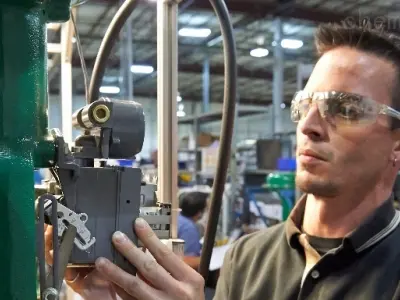
Electrical-to-Pneumatic Conversion (I/P Conversion): The control drive signal is transmitted to the I/P electrical converter. The air supply reaches the nozzle through a constant throttling orifice (constant air resistance). The electronic module's drive signal controls the electromagnetic coil of the I/P converter, causing the armature to move. The armature moves the baffle closer to or further away from the nozzle, changing the nozzle back pressure, thus converting the electrical signal into a pneumatic signal and outputting a pneumatic pressure signal to the pneumatic amplifier.
Pneumatic Amplification and Output: The pneumatic amplifier amplifies the pneumatic pressure signal from the I/P converter, providing two pneumatic outputs (port A and port B). When the input signal increases, the pressure at output A increases, and the pressure at output B decreases; when the signal is 12mA, the pressures at ports A and B are approximately equal; when the signal decreases, the pressure at port B increases, and the pressure at port A decreases. These two pneumatic pressure signals are used to control the pneumatic actuator, driving the valve.
Valve Position Feedback and Closed-Loop Control: A feedback magnetic strip installed on the valve stem moves with the stem. A Hall sensor detects the change in the magnetic strip's position, feeding the valve position signal back to the electronic module. The electronic module continuously compares the input control signal with the valve position feedback signal. When the valve position reaches the correct position consistent with the input signal, the deviation approaches zero, the drive signal of the I/P converter stabilizes, and the pneumatic amplifier output pressure also stabilizes, completing a positioning control cycle.
Status Monitoring and Diagnostics: Three pressure sensors inside the positioner monitor the pressure at the inlet, outlet A, and outlet B, respectively. Combined with the position feedback from the pneumatic amplifier, this enables real-time monitoring of the valve status. If an anomaly is detected (such as gas source leakage or excessive valve position deviation), diagnostic information can be transmitted to the control system via the HART protocol, prompting operators to perform maintenance.
Through the coordinated operation of the above components, the DVC6200 positioner achieves precise position control of the valve, ensuring that the valve opens and closes accurately according to the requirements of the control system, while also possessing high reliability, fast response, and self-diagnostic capabilities.

Our customers’ satisfaction speaks for our quality — contact us to experience the same reliable service.